

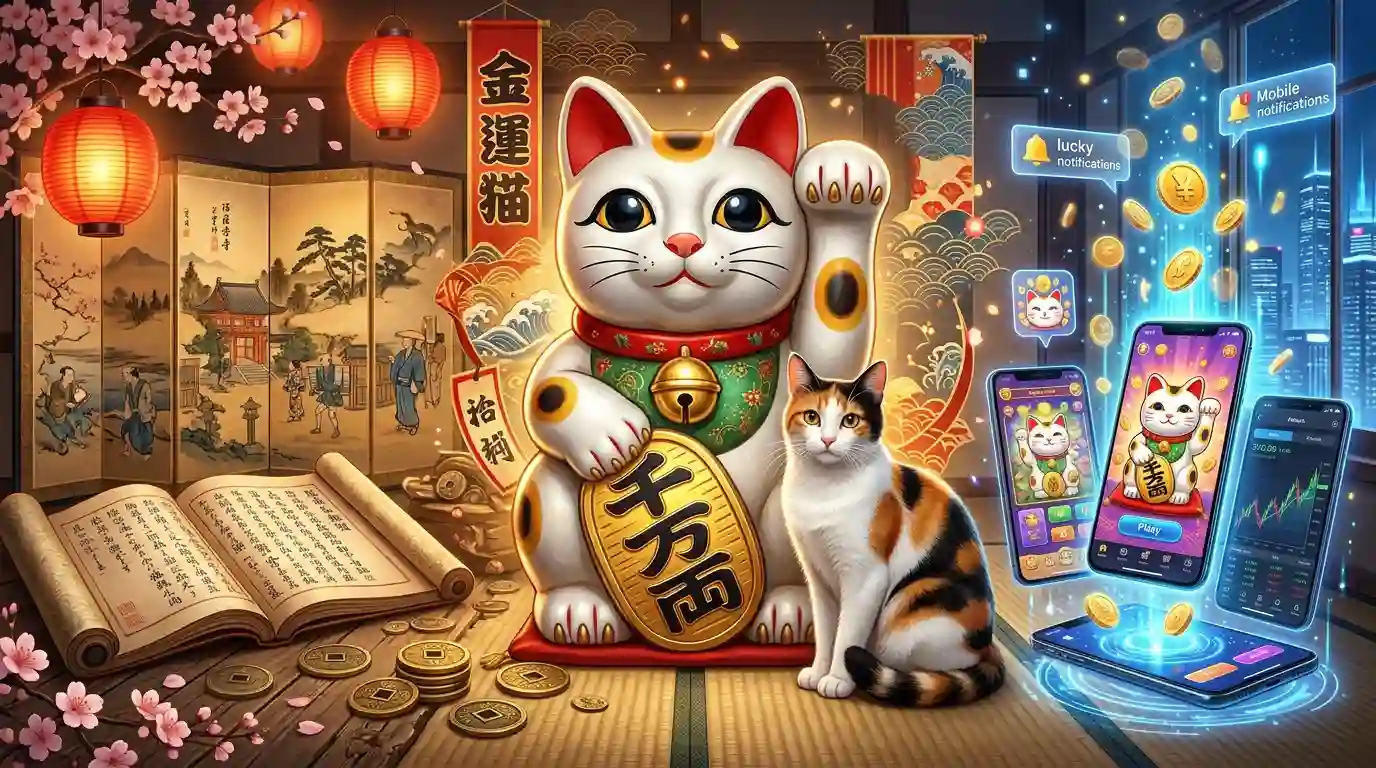

A money cat is a small cat figure with one paw raised. It is meant to bring luck and money. Most people know it by its Japanese name, maneki-neko, the “beckoning cat.”
But the name means more than one thing online. It can also mean a loan app in the Philippines, a meme coin, or a Vietnamese restaurant in Brooklyn. This guide covers all of them. Start with the lucky cat, then jump to the part you need.
What Is Considered a Money Cat?


A money cat is a cat figure that people believe attracts wealth. It sits upright with one paw lifted. The paw looks like it is calling someone in. That is why the Japanese call it maneki-neko, the beckoning cat.
Most money cats share the same look. Many wear a red collar with a bell. Many hold a large gold coin. The coin is a koban, an old Japanese oval coin. The words on it often read “ten million ryo.” That sum stands for great wealth.
You will see the figure in shops, restaurants and homes. It usually sits near the door or the cash register. The owner puts it there to invite customers and good fortune.
People use many names for it. Lucky cat. Fortune cat. Welcoming cat. Lucky money cat. Chinese money cat. Japanese money cat. All point to the same idea: a cat that calls in luck.
Some versions never stop moving. Battery and solar models wave the paw all day. Others are plain ceramic. Some double as a money box cat, a coin bank where you drop spare change. Pick the kind that suits your space.
Is a Money Cat Chinese or Japanese?


The money cat is Japanese in origin. The name maneki-neko is Japanese. The earliest stories come from Japan. The figure grew popular there during the Edo period.
Chinese communities adopted it long ago. Today it sits in countless Chinese shops and restaurants. There it is often called the Chinese money cat or the fortune cat. The Chinese name, zhaocai mao, means roughly “wealth-beckoning cat.” Most of the waving, battery-powered cats on sale are sold under that name.
So the honest answer is both. Japan made it. Chinese culture embraced it. The two traditions now overlap.
One small difference is worth knowing. In Japan, people beckon with the palm facing down. Some Western visitors read the raised paw as a wave goodbye. It is a welcome.
Where the Money Cat Came From


No one knows the exact beginning. Several legends compete. Two are told most often.
The first belongs to Gōtoku-ji, a temple in Tokyo. A poor priest lived there with his cat. He shared his meager food with it. One day a feudal lord named Ii Naotaka was caught in a storm near the temple. He saw a cat at the gate beckoning him in. He stepped inside. Lightning struck the spot where he had been standing. The grateful lord became the temple’s patron, and it prospered.
The second tale is about an old woman in Tokyo who grew too poor to feed her cat. The cat appeared in her dream. It told her to make a clay figure in its image. She did. The figures sold well, and her luck turned.
The details differ. The lesson does not. Kindness to a cat comes back as fortune. That message made the figure a favorite charm, and it has spread far beyond Japan.
What Does the Raised Paw Mean?


The paw is the most important detail. Each side says something different.
- Left paw raised: invites customers and visitors. Shops and restaurants favor it.
- Right paw raised: attracts money and good fortune. Homes and offices favor it.
- Both paws raised: a wide call for luck and protection. Some people feel it asks for too much.
Height matters in the old belief too. A higher paw is said to call from farther away. These are traditions, not rules. Choose the one that fits your goal.
What Do the Colors Mean?


Color changes the kind of luck the cat is said to bring.
- Gold: wealth and financial success. This is the classic money cat.
- White: purity, happiness and positive energy.
- Black: protection from bad luck and evil spirits.
- Red: good health and success in relationships.
- Pink: love and romance.
- Green: health and success in study.
Want money? Pick gold. Want a gentle, all-round charm? Pick white or a tri-color cat. That brings us to a common question.
Is a Calico Cat a Money Cat?


In folklore, yes. A calico has white fur with patches of black and orange. In Japan these cats are called mike. Many classic maneki-neko are painted in exactly this pattern. Many people see the tri-color cat as the luckiest of all.
The belief crossed the ocean. In the United States, calico cats are often nicknamed money cats too. Some people say a calico in the home brings good fortune.
There is a fun fact behind the legend. The genes for orange and black fur sit on the X chromosome. So nearly all calicos are female. A male calico is rare. Old tales say Japanese sailors treasured them. They believed a male mike cat could protect a ship from storms.
Is Money Cat a Cat Breed?


No. There is no breed called the money cat. Calico is a coat pattern, not a breed. It shows up in many breeds, from the American Shorthair to the Maine Coon.
Some pet sites use “money cat” for any cat with red, black and white patches. That is a nickname, not a breed standard. If you want the breed most tied to the maneki-neko look, search for the Japanese Bobtail. The mike coat is a classic in that breed.
What Are the Coin, Bib and Bell For?
Many money cats hold a koban. This was a real gold coin in feudal Japan. The “ten million ryo” on it is symbolic. It is not a price. It is a wish for enormous wealth.
The bell and bib look like the gear of a pet cat. In old Japan, wealthy households dressed their cats this way. The bib is also a nod to Jizo, a guardian figure often shown wearing one. Together they say the cat is cared for, and so is its owner.
How Does a Waving Money Cat Work?


The moving cat looks like magic. It is not. A small motor sits inside the body. It runs on batteries or a tiny solar panel. The motor swings the arm up and down. A solar cat waves in daylight and rests in the dark.
If your cat stops waving, check the batteries first. Then make sure the solar panel gets light. A cat in a dim room may need a brighter spot.
Money Cat vs Other Lucky Charms


The money cat is not the only wealth charm. It often sits beside others. Each has its own job.
- Pixiu: a Chinese mythical creature said to draw in money and guard it.
- Laughing Buddha: a smiling figure linked to happiness and abundance.
- Three-legged toad: a toad with a coin in its mouth, tied to money luck in Chinese tradition.
- Daruma: a round Japanese doll for goal setting. You paint one eye when you set a goal and the other when you reach it.
The difference is simple. The money cat invites. The pixiu protects. The Daruma tracks a goal. Pick the one that matches your need. You do not need them all.
Where to Place Your Money Cat


Placement is half the tradition. Follow these steps.
- Near the entrance, facing inward. It welcomes people and wealth.
- Near the cash register or counter in a business. It encourages sales.
- On a desk in a home office. It supports career and income goals.
- At eye level or higher. Never on the floor.
- In a clean, dust-free spot. A neglected cat is said to lose its power.
Avoid the bathroom and the bedroom. Keep the cat away from clutter. Dust it now and then. Treat it like a guest, not a prop.
Feng Shui Tips
In feng shui, the wealth corner is the far left corner of a room as seen from the front door. Many people place a gold money cat there. At work, keep it on your desk in plain sight, not in a drawer. In a shop, put it near the entrance, facing in. Keep the space tidy. By this belief, clutter blocks the flow of good energy.
How to Choose the Right Money Cat


Start with your goal. Money, customers, love or protection each point to a different color and paw. Then think about the form.
- Still ceramic cat: quiet, classic and long-lasting.
- Waving cat: battery or solar powered. Cheerful and eye-catching, but the motor can wear out.
- Money box cat: a coin bank that rewards saving.
- Size: pick one you can display where people will see it.
- Seller: buy from a seller you trust if you want a well-made piece.
Luck is a nice idea. Habits do the heavy lifting. Pair your cat with budgeting and steady saving, and it becomes a daily reminder of your goal.
Money Cat as a Gift


A money cat makes a warm gift. It suits a housewarming, a new shop, a new job or a birthday. It says: I wish you well. Match the color to the person’s goal. Gold for money. White for a calm home. Pink for love. Add a short note. It turns a simple gift into a thoughtful one.
Caring for Your Money Cat


There is no official ritual. Most people keep it simple. Wipe the figure with a soft cloth. Keep it out of strong sun so the paint does not fade. Place it with a clear goal in mind. Some people say a wish aloud when they first set it down. That part is personal.
When a cat is chipped or old, many people return it to a temple or shrine instead of throwing it away. In Japan this is a common way to retire lucky charms. Gōtoku-ji is famous for the many cat figures left there. A respectful goodbye fits the spirit of the charm.
Money Tree, Money Plant and Cat Safety


People who love lucky charms often love plants too. Then the question comes up: is it safe around my cat?
The money tree (Pachira aquatica) is listed as non-toxic to cats by the ASPCA. The jade plant and pothos are different. Both are nicknamed “money plant,” and both are toxic to cats. So the answer to “is a money plant cat safe?” depends on which plant you own.
Check the Latin name before you buy. If your cat chews a toxic plant, call your vet right away.
Money Cat in Culture


Maneki-Neko Day and Tokoname


Japan marks a Maneki-neko Day on September 29. The numbers 9 and 29 can be read as “ku” and “fuku,” close to the words for “luck comes.” The city of Tokoname in Aichi Prefecture is a well-known center of maneki-neko making. It has a long pottery tradition and a street lined with lucky cats.
Money Cat Tattoos


A money cat tattoo usually stands for luck, prosperity and protection. Wearers often choose the color and paw for the meaning they want. Talk through style and placement with your artist before you commit.
Meowth and Pop Culture


The figure appears in games, anime and shop windows around the world. The Pokémon Meowth, with a gold coin on its forehead, is widely seen as inspired by the maneki-neko.
Other Things Called Money Cat
Search the name and the lucky cat is only one result. Three other brands share it. They have nothing to do with each other. Here is how to tell them apart.
MoneyCat Loans in the Philippines
MoneyCat is an online lender in the Philippines. It offers short-term cash loans in pesos, from PHP 500 up to PHP 20,000. You apply on its website or in the MoneyCat app. Its site advertises a free first loan, with 0% interest and no processing fee for first-time borrowers.
Applicants must be Filipinos aged 22 to 60 who live in the Philippines. The money goes to a bank account in the borrower’s name. Approval can take as little as 5 minutes, or up to 24 hours.
Is MoneyCat a Legit Loan App?
It appears to be licensed. Moneycat Financing Inc. appears on the Securities and Exchange Commission (SEC) list of recorded online lending platforms. The Moneymax review gives its SEC registration number as CS201953073 and its Certificate of Authority as No. 1254. A 2021 government reply to a public records request lists the same numbers.
Do not take anyone’s word for it, mine included. Check the current SEC list yourself before you borrow. Lists change.
Licensed does not mean cheap. For repeat loans, the MoneyCat site lists a top rate of 11.9% per month, or 145% APR. That is expensive. Borrow only what you can repay on time. Keep the free first loan for a real need.
MoneyCat Harassment: What to Know
Lending app harassment is a real problem in the Philippines. In 2025 the SEC reported thousands of complaints about unfair debt collection, most of them against unregistered lenders. The usual tactics are texts to your contacts, public shaming and threats.
Borrowers have posted complaints about many lending apps, licensed or not. A complaint is not a ruling. Read recent reviews and judge for yourself.
If a lender harasses you:
- Save screenshots of every message.
- Write to the lender and state your complaint.
- File a complaint with the SEC about unfair debt collection.
- Take privacy abuses to the National Privacy Commission under the Data Privacy Act of 2012.
Think twice before you let any app read your contact list.
How to Delete a MoneyCat Account
I did not find a published step-by-step guide. Start in the app. Open the settings or help menu and look for an account option. If none exists, contact support and ask in writing to close your account and erase your data.
Pay off any open loan first. Closing an account does not cancel a debt. The Data Privacy Act of 2012 gives you rights over your personal data, but a lender may keep records the law requires it to keep.
MoneyCat Asia
People who search for MoneyCat Asia are often trying to learn who runs the lender. Moneymax describes MoneyCat Financing Inc. as a multinational fintech company. The SEC license covers its Philippine business. Always confirm the legal name and registration number of whichever MoneyCat you deal with. Each country has its own regulator.
How to Check a Lender on the SEC List
It takes five minutes.
- Open the SEC website and find the list of recorded online lending platforms.
- Search for the app name. Then search for the company behind it.
- Match the company’s registration number with the one shown in the app or on its website.
- If the app is missing from the list, do not borrow.
What Does 11.9% a Month Really Cost?
The rate is monthly, not yearly. A PHP 5,000 loan at 11.9% costs about PHP 595 in interest for one month, before any other fee. Over several months the cost climbs fast. Add up the full repayment before you accept. Compare that total, not only the speed of approval.
Repayment and Alternatives
The MoneyCat site lists online banking, mobile payment and over-the-counter options. Late payment can bring extra fees, so pay on time. The site also says early repayment can help your credit standing.
Before you borrow, look at other options. Members may qualify for SSS or Pag-IBIG loans, which are government-backed. An employer salary advance or a credit union may cost less. A small emergency fund beats any loan.
The Money Cat Meme Coin
$MONEYCAT is a meme coin. Its brand is “the cat with expensive taste.” The story follows a cartoon cat with nine lives, diamonds on his neck and big ambitions. Fans share art on a “wall of flex,” and the community lives on Telegram and X as @MoneyCatRH. It calls itself the Money Cat Club.
At the time of writing, the site said the contract address would be announced at launch. Its own disclaimer is blunt. Meme coins are highly speculative. The token has no intrinsic value and no promise of return. It is for entertainment. It is not financial advice.
Treat it that way. Never put in more than you can afford to lose.
Watch for the usual scam signs. An anonymous team. Promises of guaranteed returns. Pressure to buy right now. A contract address you cannot verify. Meme coins can lose most of their value fast, and some are outright rug pulls. If it feels rushed, walk away.
Money Cat in Brooklyn
Money Cat Vietnamese American is a restaurant at 554 Wilson Ave in Bushwick, Brooklyn, NY 11207. It serves Vietnamese food with an American twist. Slow-roasted brisket meets pho. Reviewers and a Snackpass profile mention the Money Pho, the Coconut Curry Pho and a glowing pink dining room.
The restaurant’s website offers online ordering for pickup and delivery. Hours and menus change, so check before you go.
A Japanese-inspired restaurant also called Money Cat was announced for Houston’s Upper Kirby area in 2022. It is a different business, so check the address before you go.
A Quick Check Before You Trust Any Online Lender or Coin
- Confirm the lender is registered with the SEC and the Department of Trade and Industry (DTI).
- Look for a real address and working contact details.
- Read the interest rate, fees and repayment terms before you accept.
- Use a secure (https) site with a clear privacy policy.
- Read independent reviews, not only testimonials on the lender’s own site.
FAQ
A cat figure with one raised paw, believed to bring luck and wealth. Its Japanese name is maneki-neko.
Japanese in origin. Chinese communities adopted it, and it is now popular in both cultures.
Tradition says the right paw draws money. The left paw invites customers.
In folklore, yes. Tri-color cats are widely seen as lucky, and many maneki-neko use that pattern.
No. It is a nickname for lucky cats and calico coloring, not a breed.
The money tree (Pachira aquatica) is listed as non-toxic to cats. Jade plants and pothos, both called money plants, are toxic.
Moneycat Financing Inc. appears on the SEC list of recorded online lending platforms. Check the list yourself, and read the rates and fees before you borrow.
Final Thoughts
The money cat is more than decoration. It is a centuries-old symbol of welcome, hope and good fortune. Choose the color and paw that match your goal. Put it somewhere visible and clean. Pair it with practical habits like budgeting and saving.
And if you meant the loan app, the coin or the Brooklyn restaurant, you now know which is which. Check before you click, borrow or buy.
